
Every AI agent team eventually invents the same ritual.
Someone opens a spreadsheet. Someone exports transcripts. Someone says, “Let’s just review 50 conversations every Friday and look for issues.”
You find obvious bugs. You see users asking for things your roadmap did not expect. You catch the agent being weird in ways evals missed. Finally, you are looking at the actual product instead of arguing from vibes.
Then week three arrives. There are 900 new conversations. The spreadsheet has 17 columns nobody fills consistently. The PM is behind. The founder still wants to read every bad session personally.
That is the manual transcript review trap.
Manual transcript review is reading production conversations by hand to identify failures, user intent, friction, and improvement opportunities. Useful early. Not a system. Past volume, it becomes archaeology with a backlog.
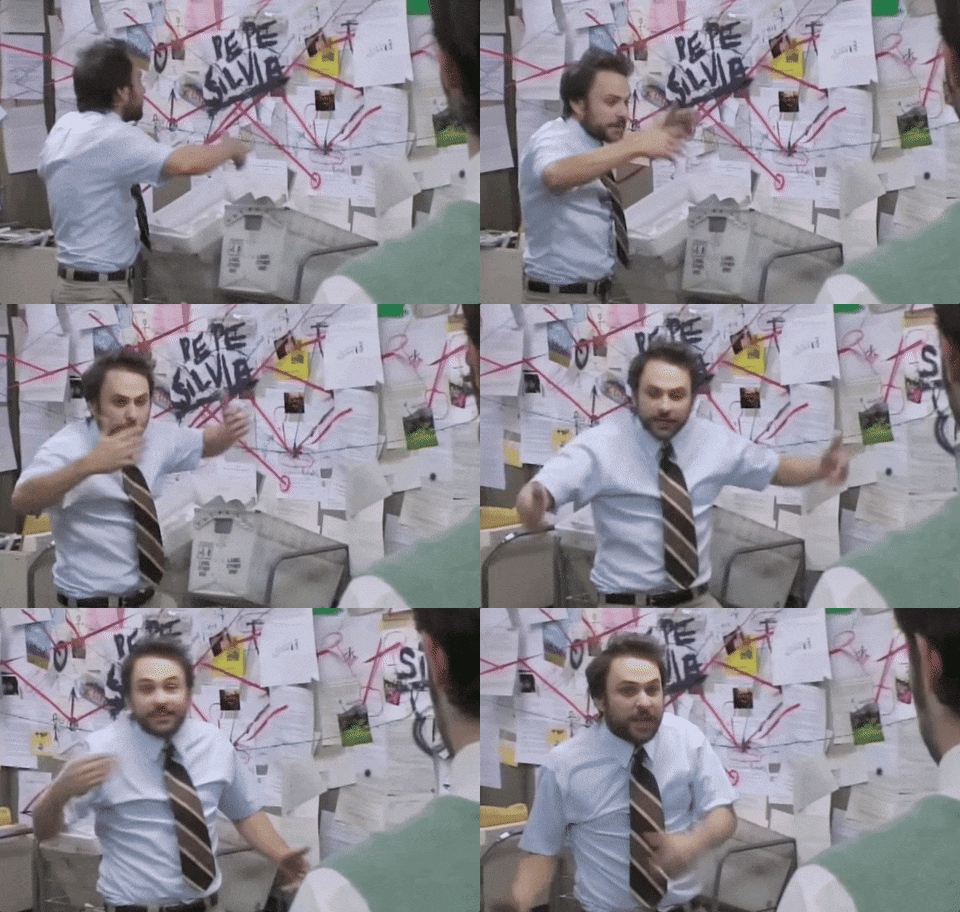
^ your third Friday transcript review, right before someone suggests another column
Why does manual transcript review feel so good at first?
Because it works at first.
If you have never read your production conversations, the first pass is a gold mine. You find repeated misunderstandings, onboarding confusion, and jobs your product technically supports but explains badly.
Founders love this phase because it feels close to the customer. There is no substitute for seeing the raw moment where a user says, “wait why did you do that.”
The mistake is thinking the first pass scales.
Manual review works when:
| Condition | Why it works |
|---|---|
| Volume is low | Humans can read enough sessions to see the shape |
| Team is small | Everyone shares the same mental model |
| Failures are obvious | Bugs jump off the page |
| Product is early | Any learning is useful |
Then the product grows. Failure gets subtler. The obvious bugs get fixed. What remains is trust decay, task ambiguity, weird edge cases, and users silently adapting around the agent.
That is when the ritual starts lying to you.
Where does the trap start?
The trap starts when manual review becomes your primary improvement loop.
It usually looks like this:
- Export transcripts.
- Sample a batch.
- Read manually.
- Tag issues.
- Discuss in a meeting.
- File a few tickets.
- Repeat, less consistently next week.
The team reads the loud sessions. The weird sessions. The ones that are easy to understand in isolation. You miss boring repeated friction. You miss user-level changes over time. You miss sessions that look fine until you compare before and after.
Worst of all, you build a false sense of coverage. “We review transcripts every week” sounds responsible. But reviewing 50 conversations out of 20,000 is a flashlight in a warehouse.

^ saying “we do weekly QA” while 93 percent of failure modes never enter the room
What breaks first?
Sampling breaks
Random samples are too random. Complaint samples are too biased. High-value user samples are better, but then you miss broad product friction. The sessions you choose become the product you believe you have.
Oversample angry users and the agent looks worse than it is. Oversample completed sessions and it looks better. Review only support escalations and you miss silent churn.
Tagging breaks
Manual tags drift fast.
One reviewer marks “scope issue.” Another marks “bad retrieval.” Another marks “unclear user request.” They may all be looking at the same thing. After a month, your taxonomy becomes a junk drawer of almost-useful labels.
This is not because the team is sloppy. Agent failures are semantic and multi-causal. The same session can be prompt, product, tool, and user education all at once.
Meetings break
Someone brings one spicy failure. Everyone reacts. The founder gets annoyed. The team files one ticket based on the most memorable conversation, not the most frequent pattern.
The vivid anecdote wins. The quiet pattern loses.
Follow-through breaks
Even when you find a real issue, the path from transcript to fix is messy. What prompt changed? What eval catches the regression? Did the fix reduce the pattern next week? Most manual review systems cannot answer without heroic bookkeeping.
And heroic bookkeeping is not a product process. It is a warning sign.
What should transcript review produce?
A good transcript review process creates decisions, not just feelings.
| Output | Bad version | Useful version |
|---|---|---|
| Failure pattern | “Agent is bad at billing” | “31 percent of failed billing sessions involve plan state confusion” |
| User intent | “People ask about exports” | “Enterprise admins ask for scheduled CSV export before upgrade” |
| Product gap | “Onboarding is unclear” | “New users ask what data the agent can access before first task” |
| Fix loop | “Improve prompt” | “Add account-state check before recommendation, then monitor correction rate” |
The point is not to remove humans. Humans are good at judgment. Stop making them do the counting, clustering, and memory.
Humans should review patterns. Machines should surface them.
How do you get out of the trap?
You move from transcript review to conversation operations.
Conversation operations means treating production conversations as an always-on product data stream. Not a Friday spreadsheet. A real loop.
The loop has four parts.
1. Auto-cluster the intent
Start by grouping conversations by what the user was trying to accomplish, not by keyword. “Export data,” “prepare investor update,” “debug checkout,” and “compare pricing plans” are intents.
Then you can ask which intents are growing, failing, upgrading, or churning.
2. Detect failure signals automatically
Do not wait for a human to notice the agent went sideways.
Track signals like:
| Signal | What it usually means |
|---|---|
| Repeated correction | Agent misunderstood or ignored context |
| Same error pasted twice | User is stuck in a loop |
| Abrupt stop after agent response | Possible abandonment |
| “I’ll do it myself” | Trust hit |
| Heavy user rewrite | Output was not usable |
| Clarification spiral | Agent cannot infer scope |
None of these are perfect. Together, they beat random sampling.
3. Route patterns to owners
Some failures belong to prompts. Some to product. Some to docs. Some to tool reliability.
If every issue goes to one giant “agent quality” bucket, nothing gets fixed. Route by likely owner, then confirm in review.
This is where Agnost tends to sit for teams: getting the right failure pattern in front of the right person with enough context to act.
4. Close the loop after the fix
This is the part most teams skip.
If you fix a failure pattern, watch whether the pattern actually drops in production. Not whether the prompt diff looks good. Whether users stop having the bad experience.
Each issue needs a production metric attached: correction rate, abandonment rate, clarification count, retry count, or cleanup burden.

^ the first time your transcript review turns into an actual improvement loop
Should teams still read transcripts manually?
Yes. Please do. Raw conversations keep you honest.
But read them differently. Do not read random transcripts hoping to discover the product truth through force of will. Read examples from patterns you already know matter. Read the top failing intent. Read before and after examples for a shipped fix.
Manual review should be depth on top of automatic surfacing.
Good use of manual review:
| Review type | Purpose |
|---|---|
| Pattern examples | Understand why a metric moved |
| High-value user sessions | Protect important accounts |
| New intent discovery | Learn what users want next |
| Fix validation | See whether the experience feels better |
Bad use of manual review:
| Review type | Problem |
|---|---|
| Random weekly batch forever | Too noisy |
| Founder reads only bad sessions | Too emotional |
| Support escalations only | Too late |
| No follow-up metric | No learning loop |
FAQ
When should a team stop manual transcript review?
Never fully stop. Stop using it as the main system once volume exceeds what the team can read consistently.
What is the biggest mistake in transcript QA?
Treating anecdotes as frequency. You still need to know whether one painful session is rare or repeated.
What should we track instead of raw transcript counts?
Track intent volume, failure rate by intent, correction loops, abandonment, clarification count, and trust loss by segment.
How often should teams review conversation patterns?
Weekly for active product teams. Daily if the agent is business-critical or recently changed.
TL;DR: Manual transcript review is useful early and dangerous when it becomes the whole quality system. It does not scale, sampling gets biased, tags drift, and vivid anecdotes beat real patterns. Keep reading transcripts, but use automation to cluster intent, detect failure signals, route issues, and measure whether fixes worked.
Reading Time: ~8 min